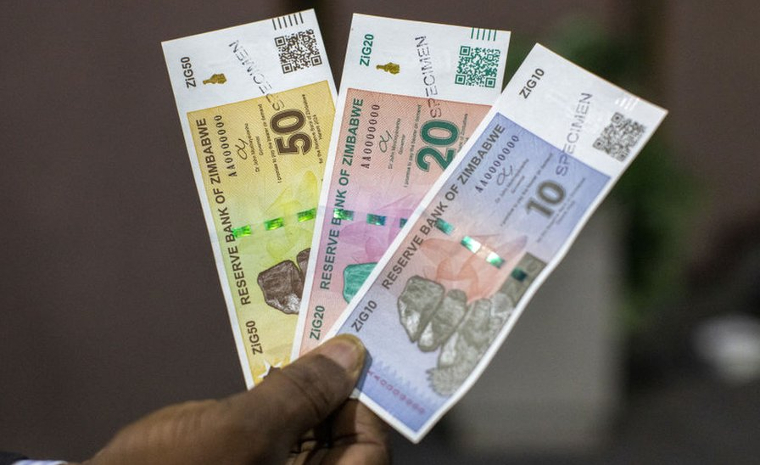
In its country report released last week, the IMF said Zimbabwe must clarify whether the use of the mono-currency will be limited to domestic transactions allowing bank deposits to remain denominated in both currencies.
It acknowledged that the ZiG had remained stable for more than a year now but the US dollar continued to dominate usage in the country.
“The monetary system remains highly dollarized. The US dollar remains the main medium
of exchange, store of value, and unit of account. The share of ZiG in monetary aggregates is small at around 17 percent, prices are rarely quoted in ZiG, and salaries and goods and services transactions are typically either fully or partially paid in US dollars,” it says.
Zimbabwe must therefore take measures to increase usage and acceptance of the ZiG.
One such measure, it says, is to remove the intermediated money transfer tax on electronic transfers as ZiG transactions are mostly electronic.
ZiG is almost impossible to get in most towns except Harare where it is widely used.
Towns like Bulawayo, Gwanda, Beitbridge and Masvingo prefer the South African rand.
Zimbabwe is expected to announce its transitional plan to phase out the United dollar when it unveils its National Development Strategy 2 next month.
The IMFsays Zimbabwe must focus on price stability to shore the ZiG and must allow a market-determined exchange rate.
“Establishing a market-determined exchange rate requires reducing the RBZ footprint in the FX market by gradually re-directing surrender requirements into the market through authorized dealers and eliminating market barriers from exchange restrictions,” the IMF says.
“This is essential to make the exchange rate an effective intermediate target. It will also help narrow the gap between the WBWS and parallel market rates, bolstering confidence in the ZiG and reducing economic distortions.”
(259 VIEWS)
Zimbabwe is one of the 27 countries in the world where the richest 0.1% of…
Zimbabwe has been ranked third among the least free countries in Southern Africa but it…
I had always considered it a curse for a wife to die before her husband.…
This is a true story about the challenges and loneliness I faced when my wife…
My first long-form article in booklet form: Why I had a girlfriend two months after…
The editor and publisher of The Insider, Charles Rukuni, has started a whatsapp channel through…