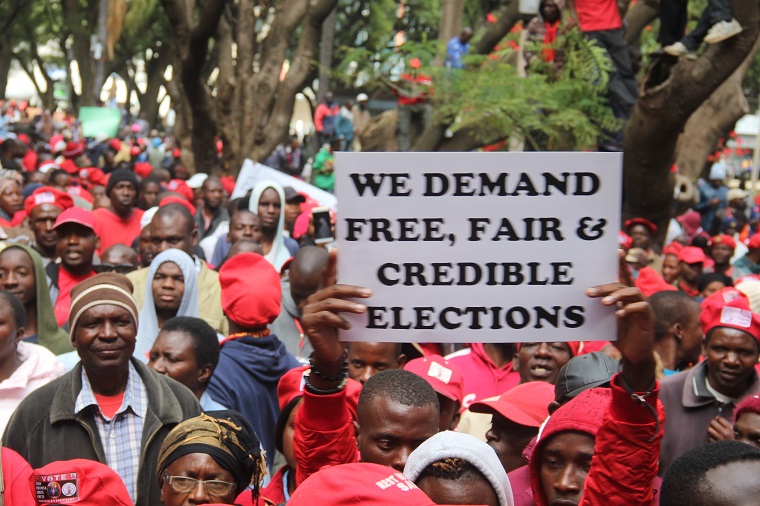
Here are some quick details on the by-elections.
Number of seats vacant: 28 seats for National Assembly and 122 Local Councils.
Number of women parliamentary candidates: 16 out of 118
Accreditation of Observers and Media: As at 28 February 2022, a total of 352 observers had been accredited, as follows: 342 local observers and 10 foreign observers. Accreditation closes 22 March 2022.
Date for by-elections: 26 March 2022
Publication of results: By 1 April 2022
Submission of election report to Parliament: 5 June 2022
Electoral Court: 18 judges of the High Court have been appointed by the Chief Justice Luke Malaba to constitute the Electoral Court. It will operate from March 1 to August 30 2022. The court will have exclusive jurisdiction to hear appeals, applications and petitions in terms of the Electoral Act, review any decision of the Zimbabwe Electoral Commission or anyone else made under the Act and shall have power to give such judgements, orders and directions in those matters as might be given by the High Court.
Uncontested seat: ZANU PF goes into the election with already one ward; Ward 14 Umguza RDC. Ncube Delay (ZANU PF) was declared the winner as he was the only candidate to file nomination papers on nomination day.
Withdrawals: Four local authority candidates withdrew their candidature after nomination. These are three MDC Alliance candidates (Chinhoyi, Masvingo and Chiredzi), and one CCC candidate in Bulawayo.
Who can vote? Anyone who was on the voters’ roll before 8 January 2022 can vote in the by-elections for Parliamentary candidates. Under the Electoral Act, the voters’ roll is closed two days after the by-election is proclaimed. In this case, the by-elections for the National Assembly were proclaimed on January 6, meaning that only those on the voters’ roll before the cut-off date – January 8 – can vote. The voters’ roll for war elections were closed as soon as vacancies occurred. Those who registered as voters after January 8 cannot vote in the by-election, but can vote in the 2023 election.
Sources: Zimbabwe Electoral Commission, Contesting parties, Government Gazette, ERC
https://zimfact.org/dashboard-fast-facts-on-zimbabwes-march-26-by-elections/
(280 VIEWS)
Four of the world’s largest banks are all in China. Assets of the Industrial and…
Zimbabwe is one of the 27 countries in the world where the richest 0.1% of…
Zimbabwe has been ranked third among the least free countries in Southern Africa but it…
I had always considered it a curse for a wife to die before her husband.…
This is a true story about the challenges and loneliness I faced when my wife…
My first long-form article in booklet form: Why I had a girlfriend two months after…