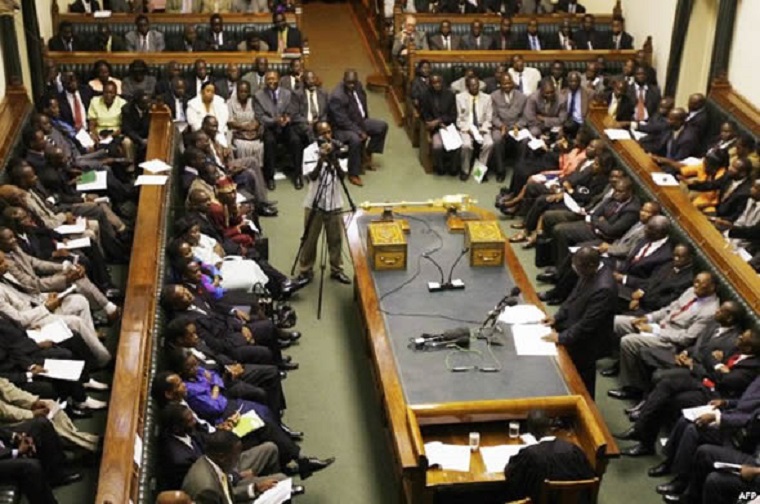
Finance Minister Patrick Chinamasa yesterday told Members of Parliament that the National Assembly was too big, and that the costs of maintaining it were too high.
He was responding to Binga North MP Prince Dubeko Sibanda over measures he had undertaken to restrain financial indiscipline, limit government borrowing on the local market, and to control unnecessary government foreign travel.
“Some of the government expenditure was inherited through our new constitution. We inherited a very large Parliament, lots of commissions and provincial entities. All those need to be funded and it is our constitutional obligation, but when I seek to fund them it is now called fiscal indiscipline,” said Chinamasa.
“The challenge we have is to contain expenditure, and a lot of that expenditure is necessary, and of course we have to live within our means.”
Zimbabwe’s Parliament has 350 members — 80 senators and 270 members of the National Assembly — who earn a gross salary of $1 124 per month and $1 046 representation allowance.
Parliament has a budget of $30 million for the entire year.
With falling tax revenues and little access to concessional lines of credit from international lenders, Zimbabwe relies on Treasury Bills to finance its operations.
In April, Finance Minister Patrick Chinamasa said the government had issued Treasury Bills totalling $4.417 billion since 2014.
In the quarter to March this year, domestic debt stood at $4 billion, 40 percent higher on the prior year, according to latest Treasury data.
President Robert Mugabe’s predilection for foreign travel remains undimmed.
Last year, the frequent flier made at least 20 trips abroad, spending $36 million in the first 10 months, up from $33 million the previous year, according to Ministry of Finance figures.
By end of November, foreign travel expenses at $44.9 million had overshot the budgetted $20.7 million by more than 100 percent while domestic travel took up $6 million against a target of $5.3 million.
Chinamasa said government borrows to pay civil servants salaries.
The $20 million released by government for the completion of Tokwe Mukosi was also borrowed locally.
The revival of Cairns and resources group, RioZim was funded through public borrowings, he added.
“There is no country which is able to provide physical cash. In this country, deposits are $7.2 billion and we cannot give $7.2 billion in physical cash because if we need physical cash we should first export so that we can buy physical cash from America,” he said.
“There is a lot of hoarding and we have taken companies to court for failure to bank since 2009.”
Continued next page
(304 VIEWS)
This post was last modified on June 29, 2017 8:33 am
Zimbabwe has been ranked third among the least free countries in Southern Africa but it…
I had always considered it a curse for a wife to die before her husband.…
This is a true story about the challenges and loneliness I faced when my wife…
My first long-form article in booklet form: Why I had a girlfriend two months after…
The editor and publisher of The Insider, Charles Rukuni, has started a whatsapp channel through…
A friend who knows about my legal battle with Zimbabwe’s richest man, Strive Masiyiwa, way…