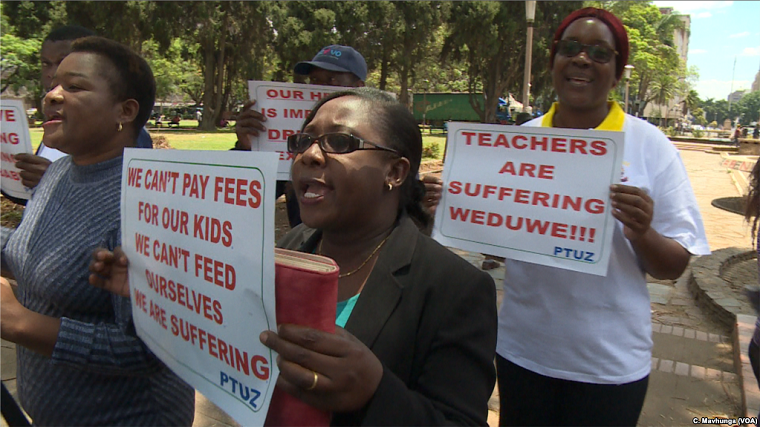
Teachers went on strike on 5 February after negotiations between the government and public-sector workers broke down, heightening political tension after last month’s violent protests that were met by a security crackdown.
Teachers’ unions met Education Minister Paul Mavima in Harare and agreed to return to work tomorrow.
The two biggest unions, the Zimbabwe Teachers Association and the Progressive Teachers’ Union, said after the meeting that the government should take advantage of the “detente to instrospect and come up with well thought out, meaningful, and long-lasting solutions on the salaries grievances”.
Failure by the government to meet their demands would see teachers going back on strike, the unions said, giving no timeline.
Mavima could not immediately be reached for comment.
Teachers, like other public-sector workers, are demanding US dollar salaries and an increase in allowances to cushion them against soaring inflation and economic hardship.
There are more than 100 000 public-sector teachers in Zimbabwe and unions say 80 percent of them are on strike.
The unions have accused state security agents of intimidating and harassing their members by visiting schools and taking down names of teachers on strike.
The Public Service Commission, which employs all civil servants including teachers, had issued a warning that it would not pay the teachers for the days they were not at work under its “No Work No Pay” principle.
Last month the Health Services Board said it was not going to pay junior doctors for the 40 days they were on strike but was instead going to advance loans to those who needed them to make ends meet.
An observer said that while he sympathised with the teachers and their plight it was a pity that the government might deduct from their meagre salaries while the trade unionists who urged them to go on strike would get bonuses for organising the strike.
(216 VIEWS)
This post was last modified on February 10, 2019 9:08 pm
A friend who knows about my legal battle with Zimbabwe’s richest man, Strive Masiyiwa, way…
Britain says amendment of the Zimbabwe constitution is a sovereign, legislative matter for Zimbabwe to…
It is now 47 years since I wrote the short story below for a South…
Zimbabwe has released its 2026 monetary policy statement in which it seeks to stabilise its…
Far from it, on paper that is. Ignatius Chombo was one of the longest serving…
Zimbabwe on Thursday announced a ZiG290.9 billion budget with revenue expected to be ZiG287.6 billion,…