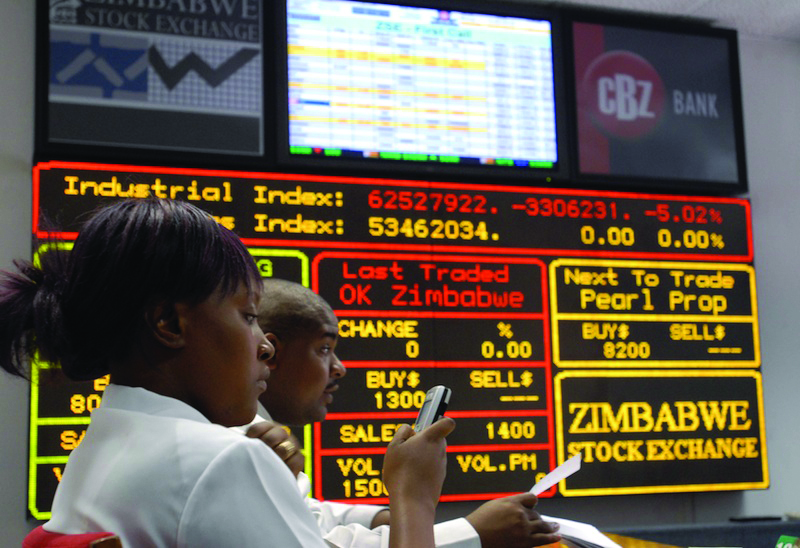
The Zimbabwe Stock Exchange recorded its highest annual turnover since dollarisation in 2009, amounting to $694.8 million in 2017 after a huge sell-off in November as former president Robert Mugabe’s 37-year grip on power came to an end.
The end of Mugabe’s regime at the hands of the military and the rise of Emmerson Mnangagwa as his replacement gave new hope for an economic reboot for the country’s stuttering economy.
Mnangagwa, under pressure from restless Zimbabweans and would-be investors desperate for a new direction, has promised to push through tough economic and political reforms.
The year-long stock market bubble, which started in October 2016 as investors scrambled for tangible assets before government rammed its bond note currency on the market, finally burst when it became clear that a new economic direction was on the horizon with Mugabe’s demise.
In November alone, the local bourse recorded a total monthly turnover amounting to $207.5 million, about 30 percent of the total turnover recorded in the year.
In the same month, the stock market’s valuation dropped by $6 billion in eight days, starting from November 15, as the market underwent a drastic self-correction.
However, on an annualised basis, the mainstream index gained 130.42 percent to 333.02 points in the year while the mining index also advanced 143.38 percent in the same period.
Market capitalisation rose by 139 percent in the year to close at $9.6 billion while average monthly turnover increased from $16.15 million in 2016 to $57.9 million.
The largest company by market share, Delta saw its share price grow by 80.79 percent to at 160 cents. The telecommunications giant, Econet’s valuation more than doubled at 207.2 percent to 92.16 cents.
Padenga, Old Mutual and Innscor advanced 241.94 percent, 58.09 percent and 108.33 percent to 54.71 cents, 552.06 cents and 100 cents in that order.
National Foods and BAT were up 80.43 percent and 134.1 percent to 650 cents and 3 570.05 cents respectively, while Seedco advanced 98.02 percent to 200 cents.
Simbisa and Hippo also picked up 193.75 percent and 402.86 percent to close at 47 cents and 176 cents respectively in the year.
Continued next page
(206 VIEWS)
This post was last modified on January 3, 2018 1:35 pm
Page: 1 2
Zimbabwe has been ranked third among the least free countries in Southern Africa but it…
I had always considered it a curse for a wife to die before her husband.…
This is a true story about the challenges and loneliness I faced when my wife…
My first long-form article in booklet form: Why I had a girlfriend two months after…
The editor and publisher of The Insider, Charles Rukuni, has started a whatsapp channel through…
A friend who knows about my legal battle with Zimbabwe’s richest man, Strive Masiyiwa, way…