If they implement the political and democratic reforms needed to win the financial support the economy needs from international donors, they’re likely to lose the next election.
If they don’t, their people, propelled by the extreme hardship brought about by austerity measures imposed by the International Monetary Fund and World Bank, may remove them through an uprising.
Already a currency devaluation has slashed the value of wages by 90% in six months.
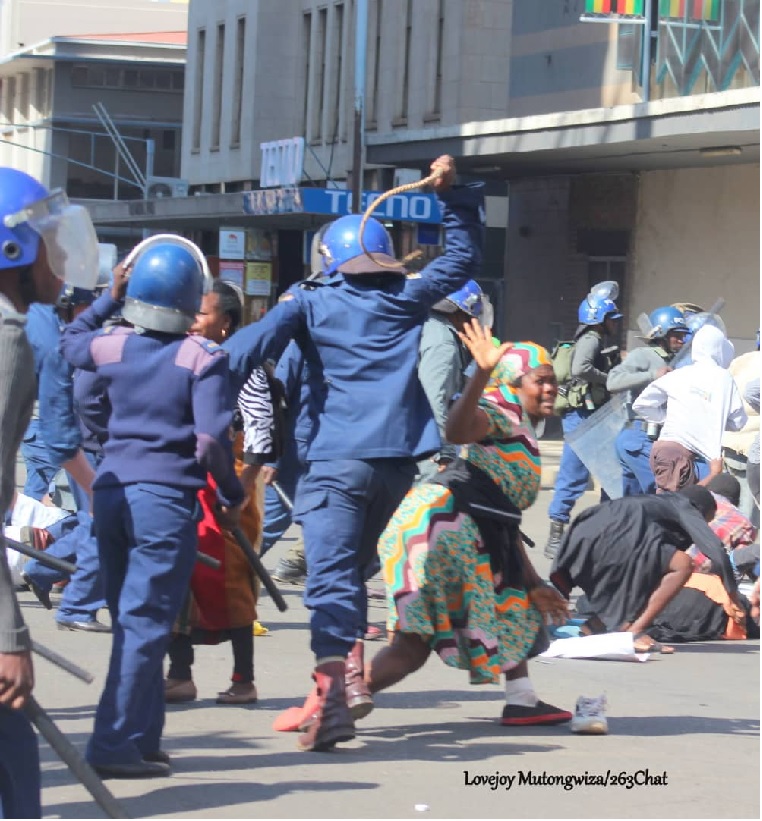
That dilemma was manifest on August 16 in full view of journalists and tourists watching from the terrace of the best-known hotel in the capital, Harare.
Below, a crowd of about 200 demonstrators peacefully singing in protest was violently broken up by riot police, who left a woman lying unconscious in the middle of a major intersection.
Less than an hour earlier, a court had ruled the gathering illegal.
“The desperation of most Zimbabweans means that future sustained protest movements are likely,” says Mathias Hindar, an analyst in London at Falanx Assynt, a risk consulting firm.
“Continued brutal crackdowns will thus increase the risk of Zimbabwe reaching a tipping point, similar to movements in Sudan and Algeria, where sustained protest brought down entrenched regimes.”
A day before the protest, Finance Minister Mthuli Ncube sat in his office and spoke of the country’s bright future and the weekly fuel price hikes he says are needed to balance the budget.
“We can declare victory on the fiscal front,” he said. “Everything that I say I implement.”
That progress is hard to see at street level.
In downtown Harare, vendors line cracked sidewalks in hopes of selling their meager goods—single heads of garlic, loose batteries, and bits of ginger.
“It’s not easy, but I have to look after other members of the family, including my grandmother,” says Solomon Mufandaedza as he crouches behind a sheet of plastic from which he displays pieces of ginger, small parcels of roasted peanuts, and a few avocados.
The 22-year-old starts selling his wares at 6 am six days a week in Harare.
A basic refrigerator retails for the equivalent of about seven months’ gross salary for a civil servant, a member of the country’s middle class.
Few can afford to shop for such items.
Ncube, a Cambridge-trained economics professor, says the situation is similar in neighboring South Africa, where he once lived. That’s untrue. In South Africa an average monthly salary for a government worker is enough to buy six refrigerators.
Continued next page
(250 VIEWS)
Page: 1 2
Four of the world’s largest banks are all in China. Assets of the Industrial and…
Zimbabwe is one of the 27 countries in the world where the richest 0.1% of…
Zimbabwe has been ranked third among the least free countries in Southern Africa but it…
I had always considered it a curse for a wife to die before her husband.…
This is a true story about the challenges and loneliness I faced when my wife…
My first long-form article in booklet form: Why I had a girlfriend two months after…