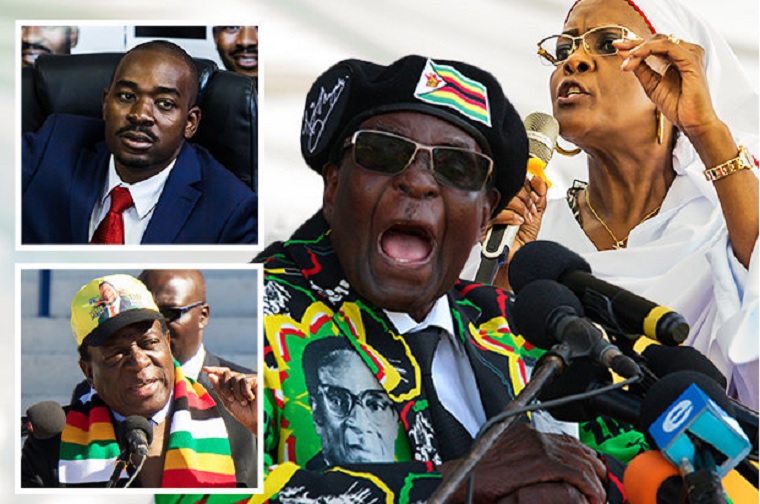
Last November’s “not a coup” replaced Mugabe with his former deputy Emmerson Mnangagwa, who had gradually but decisively been assuming control of the levers of power.
While some commentators anticipated that the elections would be postponed amid the upheaval of changing leaders for the first time since liberation from white minority rule in 1980, Mnangagwa stuck to the 2013 constitution’s timetable and elections were held on Monday.
For the first time, the former deputy headed the ballot for the ruling ZANU-PF party.
Mugabe’s departure is not the only novelty of this ballot. Also missing is Morgan Tsvangirai, opposition stalwart of the Movement for Democratic Change, or MDC, who contested the presidency in 2002 and at every election since.
Tsvangirai carried considerable moral authority in the early years of this century, holding together a coalition of opposition, trade union and progressive forces, and bearing the scars of beatings at the hands of ZANU-PF.
After he was denied an official victory in the 2008 elections, the outcry installed an internationally-brokered national unity government that survived until the 2013 election.
By then, Tsvangirai’s lustre had waned, and since then his coalition has only become more fractured. He died in February this year.
Inheriting the MDC mantle is lawyer Nelson Chamisa, contesting these elections for the seven-member MDC Alliance.
Chamisa turned forty earlier this year, only just attaining the age qualification for presidential candidates. In a society where deference to age is deeply ingrained, Chamisa’s youth has presented a challenge.
On the up side is the desire for generational change in leadership and the appeal to an overwhelmingly youthful population (although a quarter of the population is under eighteen and too young to vote).
Chamisa’s relative youth is not the only factor that made his MDC inheritance a contested one. His ascension pushed aside a senior female MDC figure, Thokozani Khuphe, who had been Tsvangarai’s deputy and served as deputy Prime Minister in the national unity government.
Continued next page
(737 VIEWS)
This post was last modified on August 1, 2018 9:48 am
Zimbabwe is one of the 27 countries in the world where the richest 0.1% of…
Zimbabwe has been ranked third among the least free countries in Southern Africa but it…
I had always considered it a curse for a wife to die before her husband.…
This is a true story about the challenges and loneliness I faced when my wife…
My first long-form article in booklet form: Why I had a girlfriend two months after…
The editor and publisher of The Insider, Charles Rukuni, has started a whatsapp channel through…