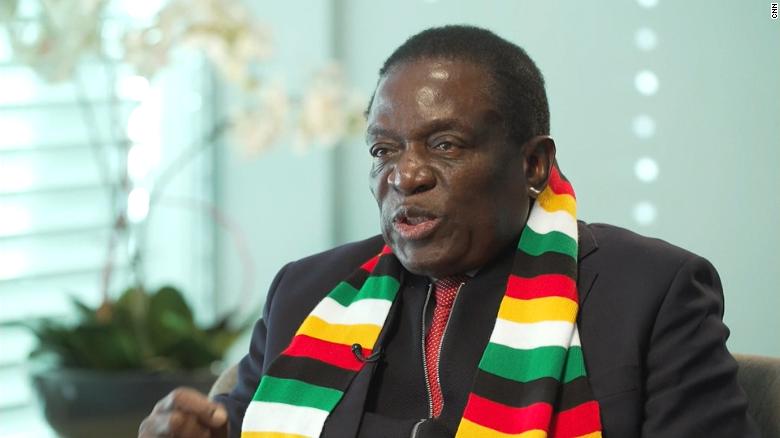
“THE land resettlement was a huge success in terms of our people, 367 000 of our people, back in possession of the land,” says President Emmerson Mnangagwa of the expropriation of most of Zimbabwe’s white-owned farmland since 2000—a move that wrecked the economy and pushed millions into poverty.
Was it fair that bigwigs of his ruling ZANU-PF party took several farms each?
“No, no, it is one farm, one person,” he says. “I have 404 hectares and I paid for the equipment myself.”
Mr Mnangagwa admits, however, that Zimbabwe “became almost a country without friends” under Robert Mugabe, who was ejected in a coup last year.
Now “Zimbabwe is open for business,” says Mr Mnangagwa, speaking in his home in Borrowdale, the poshest suburb of Harare, the capital.
Stockily built, with watchful hooded eyes and a friendly gap-toothed smile, Mr Mnangagwa is viewed as a pragmatist.
And he says much to reassure Western diplomats and investors.
He wants to arrange compensation for those whose land was seized. But his economic vision is hardly liberal.
He extols a “command” model where agriculture is guided by government.
He blames the economy’s collapse on sanctions, even though these were targeted on leading figures such as himself.
He testily rejects a suggestion that they were far lighter than those levelled against the white-supremacist regime of Ian Smith before Mr Mugabe took over in 1980.
“You are plain ignorant,” he tells The Economist.
He knows that the West will not support Zimbabwe until the coming elections have been deemed free and fair, and insists they will be.
But he denies that previous elections were unfair, especially in 2008, when NGOs reckoned that at least 270 activists of the opposition Movement for Democratic Change were killed.
“It was fair, very fair. Where is the evidence for violence? Not a single case was taken to the police.”
Indeed the police were part of the problem.
And will he apologise for the killing of some 20 000 members of the Ndebele ethnic group, most of them civilians, in the early 1980s when he was head of the security service?
He blithely denies that he once called dissidents “cockroaches who must be exterminated”.
“Let’s not live in the past,” he says. “The future must be harmonious.”- The Economist
(334 VIEWS)
This post was last modified on March 2, 2018 2:42 pm
Zimbabwe has been ranked third among the least free countries in Southern Africa but it…
I had always considered it a curse for a wife to die before her husband.…
This is a true story about the challenges and loneliness I faced when my wife…
My first long-form article in booklet form: Why I had a girlfriend two months after…
The editor and publisher of The Insider, Charles Rukuni, has started a whatsapp channel through…
A friend who knows about my legal battle with Zimbabwe’s richest man, Strive Masiyiwa, way…