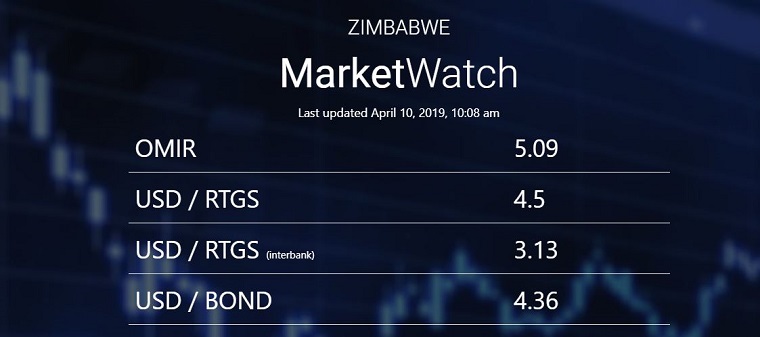
Zimbabwe began formal trading in February of what’s effectively a new currency, known as RTGS dollars, through a newly created interbank market.
While it abolished a 1:1 peg between the US dollar and the RTGS$’s predecessor, bond notes and their electronic equivalent, trading has been thin and the difference between the interbank rate and the black market remains wide.
“The rate must be allowed to float,” Bhekinkosi Nkomo, the chief executive officer of RioZim Ltd., a gold and nickel producer, said at a conference in Johannesburg yesterday. “If it’s not working, try something different.”
It’s one of the flagship policies of Finance Minister Mthuli Ncube and what he says is an initial step toward the reintroduction of a fully-fledged currency that could be traded abroad.
The country abandoned the Zimbabwe dollar in 2009 after inflation surged to 500 billion percent, rendering it worthless. It then allowed the use of various currencies including the US dollar and in 2016 introduced bond notes, which rapidly started trading at a discount on the black market.
The RTGS$ traded at a record low of 3.1383 to the US dollar on the interbank market yesterday, according to the country’s central bank. The black-market rate was 4.36.
“It’s too early to say it’s a failure,” Batirai Manhando, president of the Chamber of Mines of Zimbabwe, said in an interview, adding that ultimately trading should be liberalized to allow an effective allocation of the currency available. “It’s a positive step. 1:1 was daylight robbery.”
Ncube, who was appointed by President Emmerson Mnangagwa last year, has been tasked with reviving an economy close to collapse as a result of the policies of former leader Robert Mugabe, who was ousted in 2017.
“The market is already liberalized but these are early days,” said George Guvamatanga, permanent secretary in the finance ministry said in response to questions.
“The monetary authorities will continue to fine tune the market micro framework and this will result in more liquidity.”
Still, businesses disagree.
“Currency convertibility is the big issue and remains the big issue,” said Richard Tait, executive director of Mangwana Capital, a Zimbabwe-based investment advisory firm.
Still, further reforms are expected to be slow.
“It’s like opening a pressurized can, you need to do it slowly,” RioZim’s Nkomo said.- Bloomberg
(185 VIEWS)
Four of the world’s largest banks are all in China. Assets of the Industrial and…
Zimbabwe is one of the 27 countries in the world where the richest 0.1% of…
Zimbabwe has been ranked third among the least free countries in Southern Africa but it…
I had always considered it a curse for a wife to die before her husband.…
This is a true story about the challenges and loneliness I faced when my wife…
My first long-form article in booklet form: Why I had a girlfriend two months after…