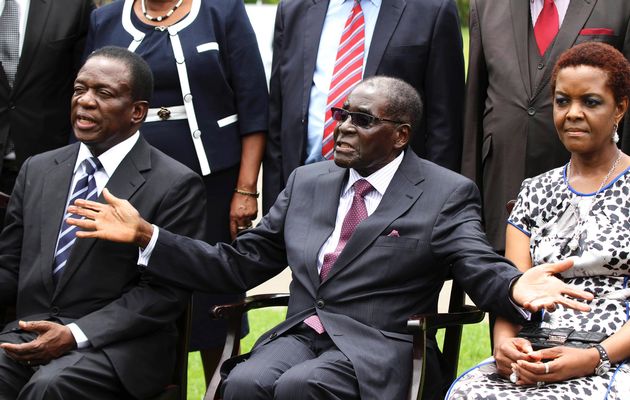
Zimbabwe’s financial troubles, which have seen the country fail to pay its arrears to the international financial institutions to get a new bailout and delays in paying civil servants, are accelerating the succession process, a United States-based strategic intelligence company says.
And, though the next elections in Zimbabwe are not scheduled until 2018, the Zimbabwe African National Union-Patriotic Front is already laying the groundwork for a stable transition once President Robert Mugabe leaves the presidency — “either by resigning or by expiring”, it says.
“Given Mugabe's advanced age and corresponding health problems, the ruling party's leaders understand that succession may happen sooner than later,” the Austin-Texas based Stratfor says.
The current cash crisis may be the final straw because Zimbabwe is facing a real risk of running out of money by the end of this year.
“By all appearances, there is no end in sight for Zimbabwe's financial troubles,” Stratfor says. “Since at least April 2015, Zimbabwe's Finance Minister has tried to impose austerity measures, including cuts to civil servants' bonuses. At every turn, Mugabe thwarted his efforts, attacking the minister's suggestions in an attempt to preserve public support for his rule.
“But as Zimbabwe's economic problems mounted, the government seemed to reconsider its stance on the once-sacrosanct public sector, which provides the bulk of the country's formal jobs. After nearly a year and a half of resistance, the 92-year-old Mugabe reportedly entertained the Finance Minister's proposal to cut bonuses for 2016 and 2017, lay off 25 000 civil servants, close certain embassies abroad and reduce cabinet members' salaries.
“However, Mugabe's interest in austerity was short-lived. On Sept. 14, the country's Information Minister stated that the cabinet had rejected the unpopular plan and had opted instead to introduce more than $75 million in bond notes ‘equivalent to the dollar’. The announcement was met with skepticism and fears that the project would set off another period of hyperinflation.
“Without a more realistic and sustainable plan to rehabilitate Zimbabwe's economy, the government runs a real risk of running out of money by the end of the year and of increasing political instability on the eve of a historic power transition.”
Stratfor also says the cash shortage might also provide the crucial test of loyalty to the security institutions on which Mugabe has relied on for years.
“Throughout the decades of his rule, Mugabe and his government have relied on Zimbabwe's security institutions to ensure their hold on power and to suppress dissent. But even they may be starting to crack under the financial crisis facing the country,” it says.
Continued next page
(480 VIEWS)
This post was last modified on September 21, 2016 7:19 pm
Page: 1 2
Zimbabwe has been ranked third among the least free countries in Southern Africa but it…
I had always considered it a curse for a wife to die before her husband.…
This is a true story about the challenges and loneliness I faced when my wife…
My first long-form article in booklet form: Why I had a girlfriend two months after…
The editor and publisher of The Insider, Charles Rukuni, has started a whatsapp channel through…
A friend who knows about my legal battle with Zimbabwe’s richest man, Strive Masiyiwa, way…