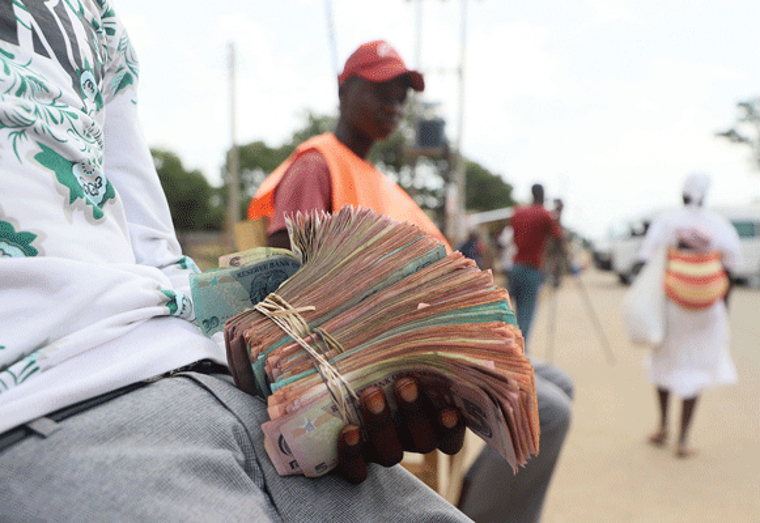
The local unit yesterday weakened past $10 160 per US dollar in the spot market for the first time since it was reintroduced in 2019, meaning that US$100 is now worth a bit more than one million Zimbabwean dollars. It remained just below that level at $9 973 according to data posted on the central bank’s website.
While for most people becoming a millionaire would be great news, in Zimbabwe it underpins the economic hardships.
The local unit has lost almost 40% of its value against the dollar on the official market so far this year, making it the worst performing currency in the world.
The depreciation means that to buy a loaf of bread in the local currency, you need to count out 100 bills of the highest denomination. That’s invoking painful memories of the past in a country where more than a third of people live below the poverty line.
In 2008, when hyperinflation prompted the central bank to issue a 100 trillion dollar note, pensions were wiped out overnight and many resorted to barter.
The local unit was scrapped a year later in favour of the US dollar before being reintroduced a decade on.
It has been volatile ever since, even as authorities have taken steps to stabilise the currency including mandating corporates to pay taxes strictly in the local unit and raising interest rates to the highest in the world.
Last year the greenback again replaced the Zimbabwean dollar as the most-used currency in the southern African nation amid surging inflation.
Day-to-day transactions are becoming increasingly hard to comprehend, as more zeros are added to the prices of goods in supermarkets and restaurants to keep track of the local dollar’s weakness.
Delta Corp, a listed beverages maker, announced on 25 January that it will switch to reporting in US dollars in its financial statements.
Banks are also frequently revising transaction limits upwards. Still, the situation is “nowhere comparable” to 2007 and 2008, Lawrence Nyazema, president of the Bankers Association of Zimbabwe, said.
“Our systems can handle everything,” he said in an interview, while urging authorities to deal with Zimbabwean-dollar inflation to help bring predictability to the local currency – the primary reason why citizens continue to shun it
“At whatever level the rate is, we just need to stabilise it,” he said.-Bloomberg
See also: A nation of poor millionaires published in February 2005
(208 VIEWS)
Zimbabwe has been ranked third among the least free countries in Southern Africa but it…
I had always considered it a curse for a wife to die before her husband.…
This is a true story about the challenges and loneliness I faced when my wife…
My first long-form article in booklet form: Why I had a girlfriend two months after…
The editor and publisher of The Insider, Charles Rukuni, has started a whatsapp channel through…
A friend who knows about my legal battle with Zimbabwe’s richest man, Strive Masiyiwa, way…