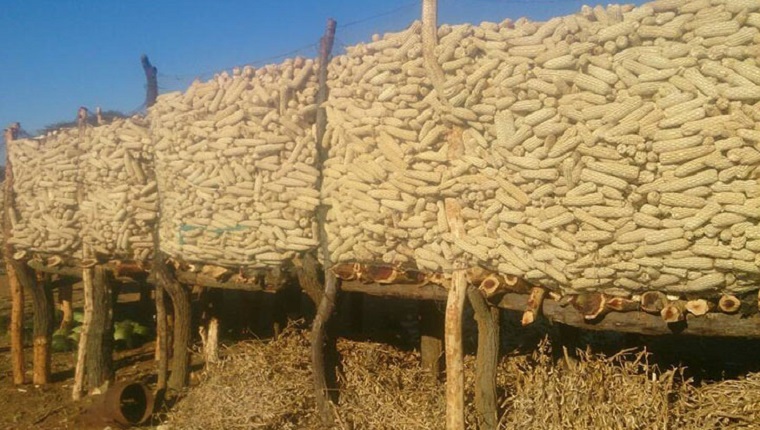
For too long the narrative has been that after land reform in 2000 and the decline of large-scale commercial farming, Zimbabwe has shifted from a breadbasket to basket case, despite plenty of evidence to the contrary documented repeatedly on this blog and elsewhere.
However, the harvest this last season has been spectacular. Does this mean that the biased commentators can finally abandon this tired narrative? What are the factors that have contributed to this success?
Good rains make a big difference, but how reliable?
Well, obviously good rainfall makes a massive difference. In the last season, this was substantial and well spread. Without significant irrigation support, most farmers must produce on dryland fields, so good rains are essential.
However with climate change this is far from guaranteed, and the recent period has shown much variability. Often unexpected extreme events such as mid-season droughts, floods, even hailstorms, destroy the crops, even if on average the season is OK. Climate change predictions suggest that this is likely to be the pattern into the future, meaning mechanisms of climate adaptation are essential.
Planting in pits: the Pfumvudza/Intwasa programme
One response to uncertain rainfall has been the Pfumvudza/Intwasa programme – a system of zero tillage cultivation involving the construction of small pits allowing water and fertility to concentrate. The government reports that yields on such plots increased from on average 1.2 tonnes per hectare in extensive dryland fields to 5.3 t/ha on Pfumvudza plots.
This is impressive, and certainly our early assessments suggested boosts, although perhaps not quite as much. In some areas waterlogging and intensive weed growth hampered crop productivity and for some a lack of labour meant that digging pits in the required format was impossible.
Overall, there is little doubt that where such intensification occurred many people across the country, especially smallholder farmers in the communal areas, gained significant yields, even though these were on very small areas per household.
Indeed, scaling up Pfumvudza techniques is very difficult without mechanisation, as it is so labour intensive. As a focused gardening technique to guarantee outputs it works well (and the adaptations that people have adopted this year, such as combining with winter ploughing, changing the pit design to avoid water pooling, often even better). But Pfumvudza will not solve Zimbabwe’s agricultural production challenge given the still relatively limited areas involved, even when these are multiplied by millions of plots.
Continued next page
(191 VIEWS)
Zimbabwe has been ranked third among the least free countries in Southern Africa but it…
I had always considered it a curse for a wife to die before her husband.…
This is a true story about the challenges and loneliness I faced when my wife…
My first long-form article in booklet form: Why I had a girlfriend two months after…
The editor and publisher of The Insider, Charles Rukuni, has started a whatsapp channel through…
A friend who knows about my legal battle with Zimbabwe’s richest man, Strive Masiyiwa, way…