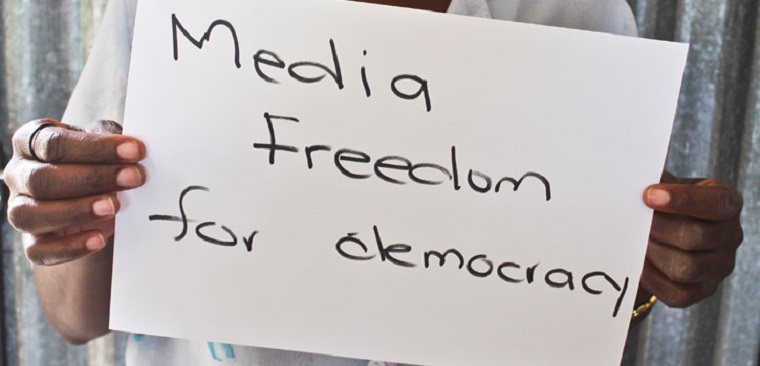
The news media is usually one of first casualties of bungled or contested elections.
From the recent US elections, the UK’s Brexit vote to Zambia’s controversial 2016 presidential elections, the mainstream news media bore the brunt of much of the criticism that followed.
In Africa, biased media coverage, most often in favour of incumbent presidents, is one of the reasons voters have little faith in the legitimacy of election outcomes.
In South Africa for example, the public broadcaster routinely comes under intense criticism at election time for being a propaganda outlet for the ruling African National Congress.
Kenya’s state broadcaster has often shed its public mandate to become the governing party’s mouthpiece during general elections.
In countries such as Uganda, Tanzania, Zimbabwe, Malawi, Swaziland and Zambia public broadcasters openly canvas for incumbent governments during elections.
Over the last few years, the nature of political campaigns in Africa has changed significantly.
Politicians and political parties are now actively shaping their public profiles.
They are engaging powerful PR agencies and even starting their own media organisations to market themselves.
In Kenya, Uhuru Kenyatta’s governing Jubilee Party has engaged the services of British PR firm BTP Advisors, as well as the data mining company Cambridge Analytica (CA).
CA played a key role in Donald Trump’s win in the US presidential elections, and in the UK’s Brexit vote through aggressive data driven campaigning.
This changing political landscape has complicated the media’s role in the coverage of elections.
But there’s still an expectation that the mainstream news media should play the role of impartial arbiter.
They are expected to provide an open platform for broader public deliberation particularly at election time.
It’s this expectation that informs criticism when the media fails to fulfil this important mandate.
Indeed, while digital technologies such as social media have now been widely adopted in Africa, millions remain unconnected to the Internet.
Continued next page
(218 VIEWS)
This post was last modified on May 20, 2017 4:34 pm
Zimbabwe has been ranked third among the least free countries in Southern Africa but it…
I had always considered it a curse for a wife to die before her husband.…
This is a true story about the challenges and loneliness I faced when my wife…
My first long-form article in booklet form: Why I had a girlfriend two months after…
The editor and publisher of The Insider, Charles Rukuni, has started a whatsapp channel through…
A friend who knows about my legal battle with Zimbabwe’s richest man, Strive Masiyiwa, way…