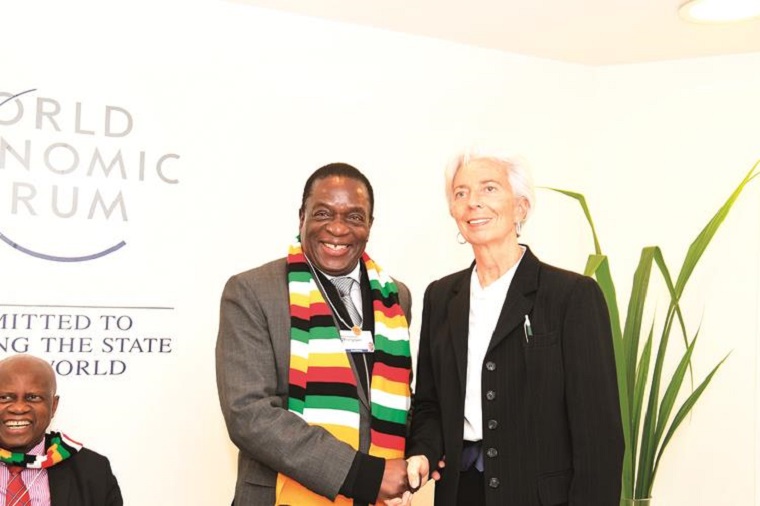
Two months into Emmerson Mnangagwa’s presidency, Zimbabwean business, industry, farming and media representatives say they are cautiously optimistic that the new President could turn around the country’s sclerotic economy – and may deliver sufficient economic gains in the next few months to triumph in elections expected in four or five months.
They say Mnangagwa has made a promising start in his bid to stabilise the economy, singling out his partial repeal of the Indigenisation and Economic Empowerment Act that choked off foreign investment and his pledge to compensate and reintegrate white farmers who lost their livelihoods in land reforms which devastated the agricultural sector.
Interviewees said that while Mnangagwa, who replaced Robert Mugabe after military intervention in November, has engendered hope of an economic recovery, they want to see early progress on reforms sustained and expanded, and believe it is incumbent on the opposition Movement for Democratic Change – comprising two parties: MDC-T and MDC-N – to overcome its factionalism to hold the president and his government to account over pledges to lift the country out of its financial mire.
The challenges facing Mnangagwa are immense as Victor Nyoni, the CEO of the Association for Business in Zimbabwe, underlined, “The economy has been destroyed. Unemployment is around 90 per cent, industrial capacity is operating at below 50 per cent and most of the companies in Zimbabwe are using archaic machinery and require retooling.”
Although tainted by his association with Mugabe and the discredited ruling party, ZANU-PF, several interviewees cited Mnangagwa’s positive language since coming to power and economic initiatives as grounds for cautious optimism.
The President of the Confederation of Zimbabwe Industry, Sifelani Jabangwe, said his faith in Mnangagwa stems from his time as vice-president, saying he showed himself to be a “man of action”, overseeing the implementation of effective pro-manufacturing policies – resulting in average capitalization growing for the first time – and an agricultural subsidy programme that contributed to record production of maize, the country’s staple food.
“So the way we are looking at it is that if that approach is implemented in terms of other challenges that the country faces, the economy should grow,” he said.
Jabangwe said that despite what the economy has been through, certain fundamentals are fairly positive.
Continued next page
(688 VIEWS)
Zimbabwe has been ranked third among the least free countries in Southern Africa but it…
I had always considered it a curse for a wife to die before her husband.…
This is a true story about the challenges and loneliness I faced when my wife…
My first long-form article in booklet form: Why I had a girlfriend two months after…
The editor and publisher of The Insider, Charles Rukuni, has started a whatsapp channel through…
A friend who knows about my legal battle with Zimbabwe’s richest man, Strive Masiyiwa, way…