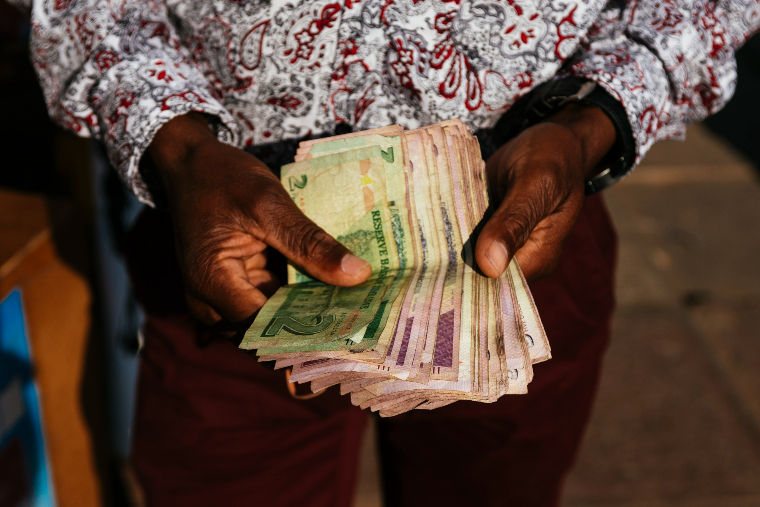
The velocity of money, which is the rate at which it changes hands, is a phenomenon that is often ignored by many analysts in Zimbabwe.
Yet factors such as low confidence in the Zimdollar can be a key driver of stability.
A reflection on the exchange rate and price developments in the last three months gives interesting insights into drivers of stability in Zimbabwe.
Monetary aggregates reveal that it was not the spike in money supply but the velocity of money that drove instability during that period.
As at June 6, 2023, when the Monetary Policy Committee (MPC) meeting was held, the level of usable balances in the economy stood at $214 billion, or US$42.8 million, at an exchange rate of US$1:$5 000.
These monetary aggregates imply that, with only US$42.8 million, it was possible to wipe away all Zimdollar usable balances in the economy.
Usable balances include excess RTGS balances, the money that is on the RTGS platform, and, therefore, readily usable for payments.
This amount has always been kept at around $0.1 billion, with any excess amount wiped into non-negotiable certificates of deposits (NNCDs), which we also included in our calculations of usable balances, as it is available for the bank’s clients in need.
The usable balances were against uncommitted bank deposits of US$448 million, which is approximately 32 percent of the total forex bank deposits of US$1.4 billion.
It is estimated that an additional US$2 billion-US$7 billion is circulating in the informal system, while an increasing amount of foreign currency is held in safe deposit boxes.
This can be interpreted to mean that, for every US$1 of usable Zimdollar, there was US$57 million-US$174 million uncommitted deposits in the banking system and circulating in the informal system.
As such, the level of US dollar relative to the Zimdollar is very high in Zimbabwe, which could also be a reflection of the high level of dollarisation — now estimated at 80 percent.
This brings us to the question of why then the Zimbabwe dollar was depreciating?
It is arguable that outside limited access to the available foreign currency in the formal system, the high velocity of money could have been the key driver of instability during the period.
If the $214 billion changes hands 10 times in a day, it has the same effect as $2.14 trillion, and if it changes hands 100 times, its effect is amplified to $21.4 trillion, and so on.
As such, no matter how much your usable balances, their effect on stability is amplified by the rate at which they are exchanged, which is influenced by many factors.
Key among these are confidence levels in the currency, and its extent of use and, therefore, demand.
As confidence in the local currency sank rock bottom, the market sought to offload it at every opportunity, making it “hot” money.
Continued next page
(353 VIEWS)
This post was last modified on August 6, 2023 9:02 am
Page: 1 2
Zimbabwe is one of the 27 countries in the world where the richest 0.1% of…
Zimbabwe has been ranked third among the least free countries in Southern Africa but it…
I had always considered it a curse for a wife to die before her husband.…
This is a true story about the challenges and loneliness I faced when my wife…
My first long-form article in booklet form: Why I had a girlfriend two months after…
The editor and publisher of The Insider, Charles Rukuni, has started a whatsapp channel through…