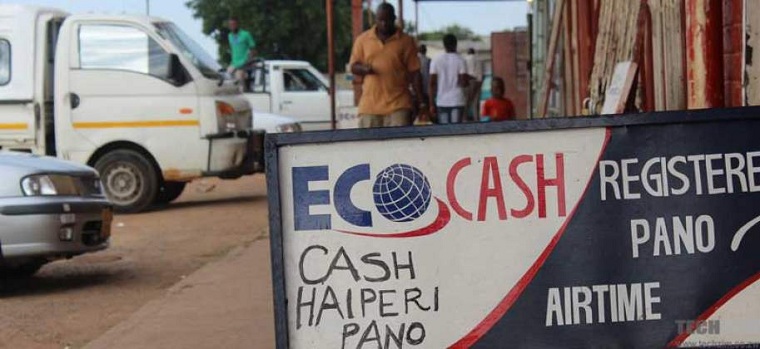
Ecocash, which took the central bank to court for freezing some of its agents’ accounts, fired back saying the central bank was to blame for the chaos because it was not acting on suspicious transactions that the mobile money platform reported to it.
Ecocash, is part of the Zimbabwe Stock-Exchange listed Cassava Smartech, which was spun-off from the country’s largest mobile phone operator Econet, owned by Zimbabwe’s richest man Strive Masiyiwa.
Ecocash took the Reserve Bank of Zimbabwe to court after the central bank had issued a directive that agents with transactions of over $100 000 should have their accounts frozen because it had not been consulted on this.
It argued that the directive would affect transactions by its over 53 000 agents as well as its 11 million customers countrywide.
Ecocash chief executive Natalie Jabangwe said the central bank had ignored most of its suspicious transactions reports (STRs).
Of the 17 STRs Ecocash reported recently, the central bank had only acted on five and ignored 12.
She said Ecocash had reported 68 STRs since the beginning of the year, but the central bank had only responded to 22. Last year it reported 100 and only got responses to 50.
“Whilst we are fully aware of our obligation to detect and report and we will continue to do so, the low response rate can be disheartening and cause for concern to us especially when you then keep accusing us of not detecting and reporting cases of abuse of the platform,” she said.
In his response to Ecocash’s application to the High Court, central bank governor John Mangudya said their investigations had revealed that some of Ecocash’s agents had an overdraft of $39 million.
“How can an entity or individual have an overdraft on an electronic payment platform such as Ecocash?” he is reported to have queried, according to the Anchor
“The applicant can only operate the payment systems in a lawful way. Operating the payment systems unlawfully through a Ponzi Scheme and shadow banking amounts to a violation of the law and does not give rise to any rights that the applicant can seek to enforce in the manner sought,” Mangudya is quoted as saying.
Continued next page
(361 VIEWS)
As a news piece, this article cites verifiable, third-party sources which have all been thoroughly fact-checked and deemed credible by the Newsroom in accordance with the Civil Constitution.Civil: Credibility Indicators
Sources Cited
This post was last modified on May 9, 2020 9:43 pm
Page: 1 2
Zimbabwe has been ranked third among the least free countries in Southern Africa but it…
I had always considered it a curse for a wife to die before her husband.…
This is a true story about the challenges and loneliness I faced when my wife…
My first long-form article in booklet form: Why I had a girlfriend two months after…
The editor and publisher of The Insider, Charles Rukuni, has started a whatsapp channel through…
A friend who knows about my legal battle with Zimbabwe’s richest man, Strive Masiyiwa, way…