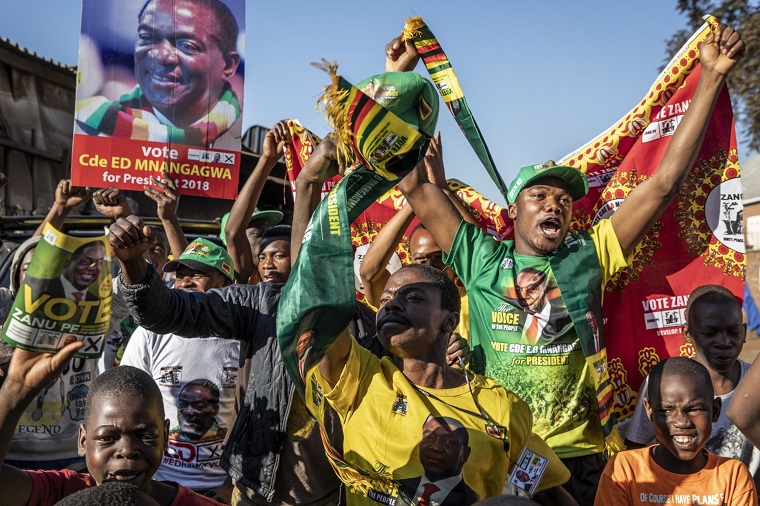
Even before the official results were announced, which gave Mnangagwa 50.8% of the vote to Chamisa’s 44.3%, the Alliance claimed that they had polling station returns (V11s) showing a ‘resounding’ victory for Chamisa.
When the Zimbabwe Electoral Commission (ZEC) released a spreadsheet of the presidential results, granulated to polling station level, the Alliance persisted in its claim that the figures published by ZEC had been altered and didn’t match the V11s in their possession.
The true numbers on the V11s would soon be revealed in a petition to the Constitutional Court, the Alliance said. This would show that ZEC had fraudulently deflated the number of votes allocated to Chamisa and inflated Mnangagwa’s tallies, and that Chamisa had won.
Yet when the matter came before the Constitutional Court, it appeared that Chamisa had all but abandoned this claim.
After the court case, several thousand V11s were posted online. A check of a random sample of the several hundred listed in the court petition proved ZEC’s numbers accurate in each instance and Chamisa’s claim false. This could be why none of these V11s were presented to the court and the claim not advanced with any enthusiasm.
Instead of pursuing this allegation, Chamisa pointed to two other numerical anomalies to try to prove his case. The first of these was that the state broadcaster, ZBC, had announced on polling day that by 5pm, about 105 000 people had voted in Mashonaland Central Province.
The MDC Alliance recruited statisticians to show that it was impossible for another 370 000 people to have voted by the time voting closed at 7pm. Therefore, the MDC claimed, the final tally of 475 000-odd was fraudulent.
This allegation required one to believe that Mashonaland Central had an incongruously low voter turnout, that ZEC had fraudulently allocated several hundred thousand votes to Mnangagwa not reflected on the V11s, or that the V11s had been altered by ZEC officers at over 1 000 polling stations – all without anyone noticing. The other possible explanation was simply that the ZBC announcement was wrong.
The MDC Alliance’s second smoking gun supposedly proving manipulation was a claim that the presidential and parliamentary tallies didn’t match. Three polls are held simultaneously in Zimbabwe’s general elections: presidential, parliamentary and local government. In the normal course of events, voters are given three ballot papers. The total votes cast in each of the three elections should match.
Continued next page
(1537 VIEWS)
This post was last modified on September 23, 2018 9:56 pm
Page: 1 2
Zimbabwe is one of the 27 countries in the world where the richest 0.1% of…
Zimbabwe has been ranked third among the least free countries in Southern Africa but it…
I had always considered it a curse for a wife to die before her husband.…
This is a true story about the challenges and loneliness I faced when my wife…
My first long-form article in booklet form: Why I had a girlfriend two months after…
The editor and publisher of The Insider, Charles Rukuni, has started a whatsapp channel through…