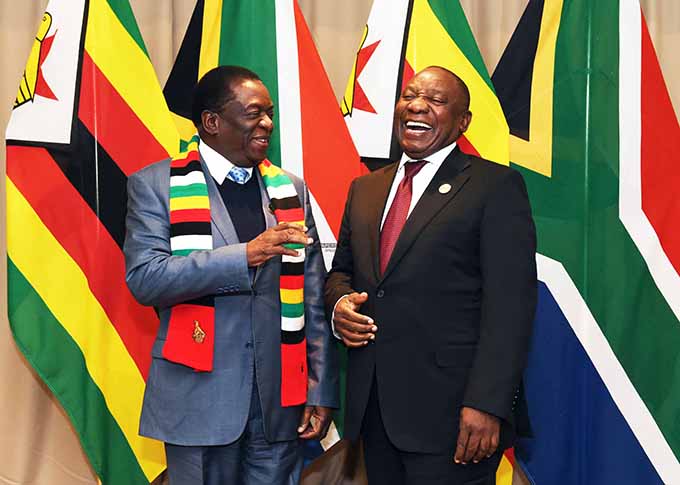
“Zimbabwe is on a path of great reforms. This needs to be supported, as Zimbabwe has turned a corner,” Ramaphosa said.
The EU which imposed sanctions on Zimbabwe in 2002 but has gradually been lifting them bit by bit, early this year extended its sanctions on Zimbabwe until 20 February 2019.
It said its decision to keep sanctions in place, despite a new leadership taking over, was taken so that the situation in Zimbabwe could become clearer.
As a result, EU travel restrictions and asset freezes continued to be imposed on 7 people: Robert Mugabe, Grace Mugabe, Happyton Bonyongwe, Augustine Chihuri, Constantine Chiwenga, Perrance Shiri and Phillip Sibanda and 1 entity, the Zimbabwe Defence Industries.
It said, however, those sanctions were currently suspended, except in relation to Robert Mugabe, Grace Mugabe and Zimbabwe Defence Industries.
The EU said those under sanctions could submit a request to the EU Council to seek a reconsideration of their respective listings before 1 November 2018 and may challenge the Council’s decision to renew them in the EU General Court.
Zimbabwe held its elections in July which were won by Emmerson Mnangagwa but the EU observer mission ruled that the elections failed to meet international standards.
It submitted 23 recommendations to improve future elections.
The recommendations were focussed on four key areas: the independence of the Zimbabwe Electoral Commission, improved level playing field, the legal framework and the inclusiveness of the process.
(294 VIEWS)
Zimbabwe has been ranked third among the least free countries in Southern Africa but it…
I had always considered it a curse for a wife to die before her husband.…
This is a true story about the challenges and loneliness I faced when my wife…
My first long-form article in booklet form: Why I had a girlfriend two months after…
The editor and publisher of The Insider, Charles Rukuni, has started a whatsapp channel through…
A friend who knows about my legal battle with Zimbabwe’s richest man, Strive Masiyiwa, way…