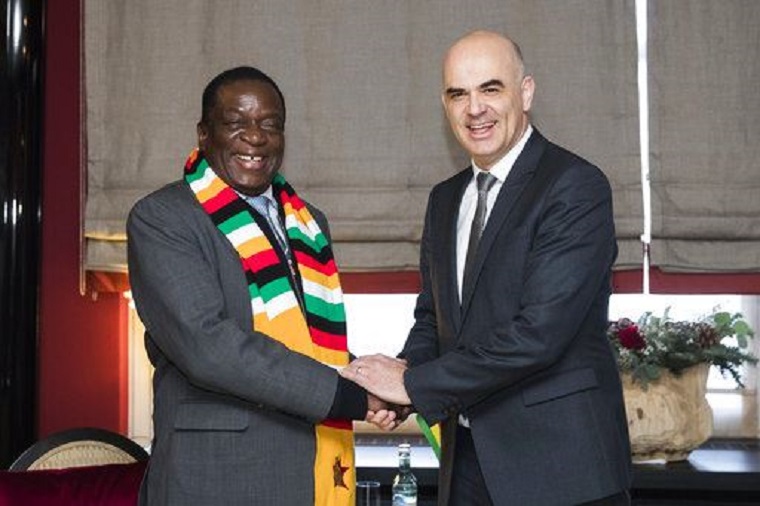
Last week at the World Economic Forum, Zimbabwe’s new president, Emmerson Mnangagwa, declared: “Zimbabwe is now open for business.”
Mnangagwa’s appearance in Davos, Switzerland, was a first for his country, which had been ruled by Robert Mugabe since independence in 1980.
Now, following Zimbawe’s apparent change of leadership last year, many in the international community are eager to invest.
The United States and other longtime supporters of Zimbabwe’s democratic forces should not, however, fall for a poorly veiled charade of a military junta.
The rush to assist a country as it emerges from the clutches of a brutal dictator is understandable, even praiseworthy.
In such situations, the United States and its allies should support the forces of freedom and economic opportunity.
This was the response in many places across Africa, including Ethiopia after the fall of Mengistu Haile Mariam, Liberia following the ouster of Charles Taylor, and most recently in Gambia.
These were true historical transitions. Zimbabwe’s is not.
In November 2017, Mugabe was placed under house arrest and ultimately ousted by his own army.
Thousands of people flooded the streets, alongside tanks and uniformed soldiers, to celebrate.
But this was no popular uprising restoring democracy; rather, it was a well-orchestrated coup designed to maintain the status quo.
In Zimbabwe, sadly, the dictator may be gone, but the dictatorship remains.
Mnangagwa is not the cartoon dictator of the past. He is savvier and knows how to play the international game.
He has pledged to hold “free and fair” elections by late August and to revive a failed economy.
A slick public relations and aggressive social media campaign have led to sympathetic press coverage and a warm reception in Davos.
Mnangagwa is hoping to attract investors and convince the United States and others to lift targeted sanctions on him and his allies for past human rights abuses.
Mnangagwa is also pushing hard for the World Bank to help to repay its massive debts and secure new loans.
Yet it’s far too soon to embrace the junta or to bail it out.
Continued next page
(567 VIEWS)
This post was last modified on February 3, 2018 8:27 am
Page: 1 2
Four of the world’s largest banks are all in China. Assets of the Industrial and…
Zimbabwe is one of the 27 countries in the world where the richest 0.1% of…
Zimbabwe has been ranked third among the least free countries in Southern Africa but it…
I had always considered it a curse for a wife to die before her husband.…
This is a true story about the challenges and loneliness I faced when my wife…
My first long-form article in booklet form: Why I had a girlfriend two months after…