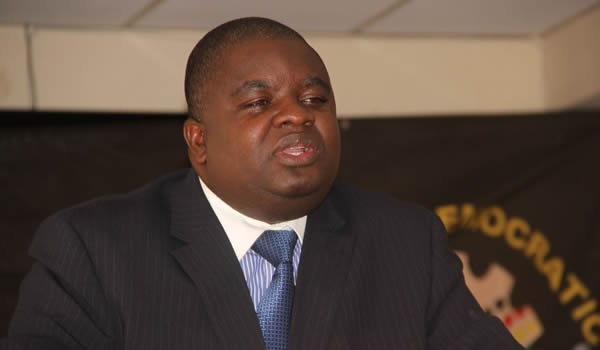
He said it did not pursue any national vision and was bereft of fiscal stabilisation measures.
“It lacks pro-active economic stimulus measures. The Minister of Finance squandered the rare opportunity to re-align the budget and tackle the crippling debt problem which he conservatively puts at $9.7 billion,” Mashakada said.
Below is his full analysis:
Monday, 12 September 2016
Analysis of the Mid-term fiscal policy review statement
Statement by the MDC Shadow Minister of Finance, Dr Tapiwa Mashakada
The Mid-Year Fiscal Policy Review Statement is a bankrupt statement which is anchored on a bankrupt Zimasset policy document. Neither does it pursue any National Vision. It is a statement that is bereft of fiscal stabilization measures. It lacks pro-active economic stimulus measures. The Minister of Finance squandered the rare opportunity to re-align the budget and tackle the crippling debt problem which he conservatively puts at $9.7 billion.
1.Stability Issues
1.1 Debt
The country is mirred in a fiscal policy crisis which is taking a heavy toll on all sectors of the economy. Clearly the Minister’s debt figures are contestable. The Minister, for reasons unknown to the Nation, was conservative with the truth when he put the total national debt at $9.7 billion. We don’t know much about the foreign debt due to the lack of transparency on debt contracting by the State. However, economists estimate the domestic debt figures as follows:
Continued next page
Given the discrepancy between the official figures and estimates from economists and economic analysts, it is necessary to have a fresh independent audit of the domestic debt.
1.2 Fiscal Space
Six months government expenditure
Total expenditures and net lending for the first six months (Jan-June 2016) stood at $2.316 billion against the budgeted target of $4billion. This represents uncontrolled expenditure to the tune of $308.4 million. During the period under review, employment costs alone gobbled $1.638 billion compared to $216 million on Operations and Maintenance; Interest ($54 million) and Capital Expenditure ($407 million).
Employments alone constitute 96.8% of total Revenue.
Six months revenue performance
Revenues to June 2016 stood at $1.692 billion compared to the Budget Estimate of $3.850 billion. At 26%, tax contribution, VAT is still the dominant revenue head suggesting that Zimbabwe is largely a supermarket economy. Compare this to company tax which is a paltry 8%. Import taxes (Excise and customs duty) contributed 28% while Individual taxes (PAYE) contributed 21%.
Six months budget deficit
The cumulative budget deficit for the six months period stood at $623.2 million compared to the Budget estimate of $150 million. The Minister reckons that by the end of the year, the budget deficit will hit the $1billion dollar mark.
From the above analysis, it is clear that government does not have the fiscal space to maneuver. Worse still, the economy is not performing. GDP growth forecast has been revised downwards from 1.7% in the budget to 1.2%. Even the 1.2% is still a very optimistic and therefore an unrealistic figure.
Continued next page
(515 VIEWS)
This post was last modified on September 12, 2016 2:49 pm
Zimbabwe has been ranked third among the least free countries in Southern Africa but it…
I had always considered it a curse for a wife to die before her husband.…
This is a true story about the challenges and loneliness I faced when my wife…
My first long-form article in booklet form: Why I had a girlfriend two months after…
The editor and publisher of The Insider, Charles Rukuni, has started a whatsapp channel through…
A friend who knows about my legal battle with Zimbabwe’s richest man, Strive Masiyiwa, way…