Movement for Democratic Change Shadow Minister for Finance Tapiwa Mashakada says the Reserve Bank of Zimbabwe Amendment Bill which is aimed at legalising bond notes, treats the notes as Zimbabwe dollars and does not talk about the export incentive at all.
Contributing to the debate on the second reading of the bill, Mashakada said the bond note was premised on a 5 percent export incentive but the bill silent on that.
“The original thinking was not to make it a general currency for everybody. It was to issue it out as an export incentive, which would then percolate in the financial system as and when exporters are paid, but that is not the case,” he said.
“So, in this Bill you will find that the issue of export incentive is silent. The Bill is silent on the original question of the introduction of the bond notes. It does not refer to the export incentive at all. It is now treating bond notes as Zimbabwean Dollars, asking this House to embrace the introduction of new legal tender, which is the Zimbabwean Dollar.
“It detracts from the original thrust of export incentive. I thought the Minister would re-couch the Bill so that it reflects the original intention that it is going to be a 5% export incentive. As the Bill stands, it is just like any other currency that is being introduced which is not based on any export incentive.”
Full contribution
HON. DR. MASHAKADA: Thank you Hon. Speaker. I rise also to proffer a few comments on this Bill that was tabled sometime back. First of all, I need to support the remarks by the Chairperson of my Committee on the problems that people are facing in accessing their monies in the banks.
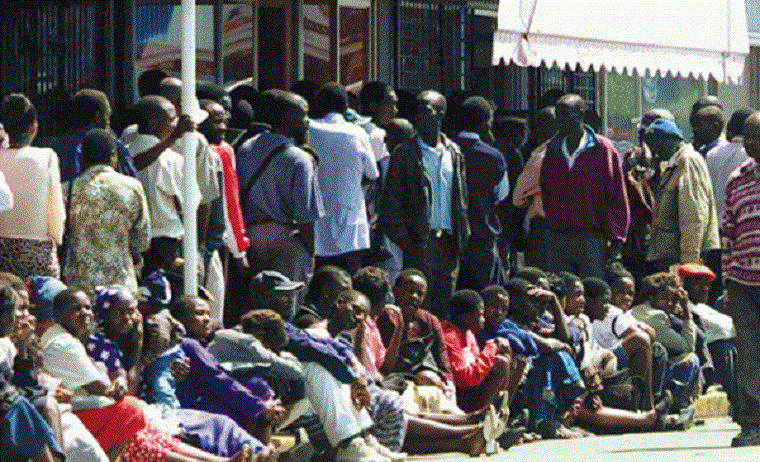
The introduction of the bond note has not brought the necessary or the much needed relief to the consumers and the general public. We all know that the queues are getting longer every day, it is a common cause. One would hope that the introduction of the bond notes and coins would ease the general liquidity crisis. From a macro-economic point of view, this issuance of bond notes in dribs and drubs will affect aggregate demand. You know, for economic activity to respond so that we stimulate production and economic activity, there has to be aggregate demand which is backed by adequate purchasing power.
If people do not have adequate purchasing power, adequate demand becomes depressed and it is also a backlash on the general economic activity in the country. That can slow growth. As you know Mr. Speaker Sir, one of the fast moving or fast growing sectors is the commercial and financial services. These sectors depend on transacting on spending and if that is limited, that can invariably affect the level of growth in the country.
Continued next page
(349 VIEWS)
This post was last modified on December 30, 2016 7:18 pm
Page: 1 2
Zimbabwe has been ranked third among the least free countries in Southern Africa but it…
I had always considered it a curse for a wife to die before her husband.…
This is a true story about the challenges and loneliness I faced when my wife…
My first long-form article in booklet form: Why I had a girlfriend two months after…
The editor and publisher of The Insider, Charles Rukuni, has started a whatsapp channel through…
A friend who knows about my legal battle with Zimbabwe’s richest man, Strive Masiyiwa, way…