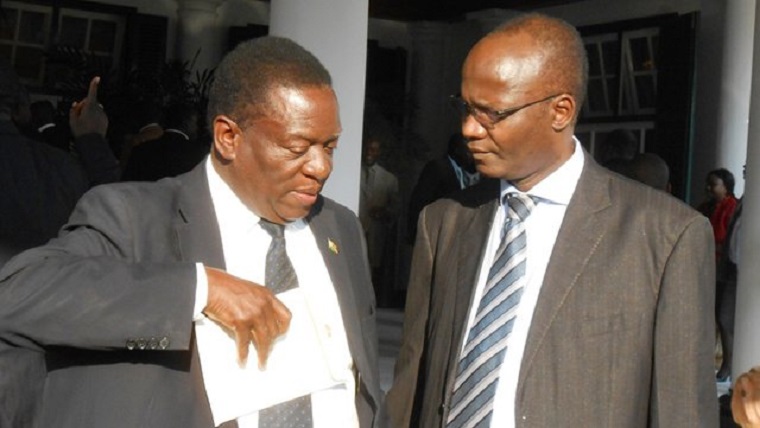
He said this in an interview with Alex Magaisa’s Big Saturday Review yesterday. Below is the relevant excerpt.
BSR: Thank you, Professor Moyo for agreeing to do this exclusive interview with us at the BSR as we approach the anniversary of the events which ousted former President Robert Mugabe’s government. Some firmly believe it was a “military coup”. Others prefer to call it a “military-assisted transition”. For months you were intimately involved in the events that culminated in that dramatic chapter in Zimbabwe’s history, so it is in the public interest to hear your reflections. One year on, which label best describes those events: military coup or military-assisted transition? Why is this characterisation important?
ANSWER: First, thank you for giving me this BSR opportunity for a conversation on the first anniversary of the momentous events of November 2017, in which tanks and bullets altered and redefined state politics in Zimbabwe in dramatic and fundamental ways whose import is yet to be fully appreciated. Second, congratulations on your excellent BSR initiative. You have done commendably well in developing the BSR into a go-to platform on Zimbabwean issues. The BSR has become the meeting-space of choice for Zimbabwean minds and others interested in everyday history around the country’s political economy and constitutional challenges.
As for me doing this BSR interview, I must say I initially thought twice about it and I was inclined to think against it. This is because I am currently working on two different but complementary books: one an autobiography (expected to be published in 2019) and another a major academic memoir (expected to be published in 2020) on state politics in Zimbabwe from 1979 to 2020. Both books extensively deal with the antecedents, facts and consequences of the November 2017 coup including some related to the BSR questions you say you want to raise with me. The autobiography focusses on my personal and political experiences while the academic memoir retraces and unpacks Zimbabwe’s state politics between 1979 and 2020 and projects it into the future by describing and interpreting the record against the backdrop of the best of competing political theories with the 2017 coup as the power point of the book. In the end, and tempted as I was to say “no, wait for my books”, I thought it would not be a worthy excuse to decline this BSR conversation on account of two books in progress.
Continued next page
(2773 VIEWS)
This post was last modified on November 11, 2018 3:43 pm
Zimbabwe has been ranked third among the least free countries in Southern Africa but it…
I had always considered it a curse for a wife to die before her husband.…
This is a true story about the challenges and loneliness I faced when my wife…
My first long-form article in booklet form: Why I had a girlfriend two months after…
The editor and publisher of The Insider, Charles Rukuni, has started a whatsapp channel through…
A friend who knows about my legal battle with Zimbabwe’s richest man, Strive Masiyiwa, way…