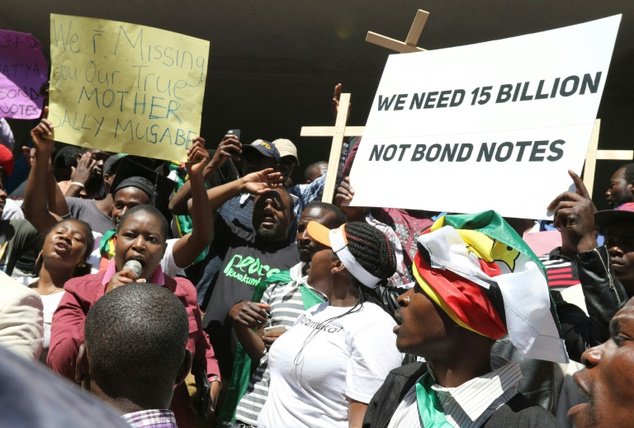
The stiff resistance that the government is facing over the introduction of bond notes, which will trade at par with the United States dollar, is largely because people do not trust the government and the banks.
According to credit rating agency, Moody’s, most Zimbabweans view the bringing in of bond notes as a re-introduction of the Zimbabwe dollar which could result in hyperinflation, goods shortages and the suffering that most people went through only eight years ago.
This view was supported by African think-tank organisation, Afrobarometer, which said the bond notes were the major drivers of protests that rocked the country in June and July.
The central bank announced plans to introduce bond notes in May.
Moody’s also said Zimbabweans were withdrawing their money from banks, despite the restrictions, because they did not trust banks.
Below is Moody’s analysis on how the current economic crisis has impacted the banking sector?
The government’s excessive treasury bill issuance has contributed to the cash shortage by draining the banking system of liquid cash assets. Although government issued T-bills can be used to settle domestic claims, they are unable to ease the physical cash crisis facing the domestic banking sector, nor can they be used to fund nostro accounts in order to finance international trade. As a result, the banking system is running critically low on physical dollars: the ratio of hard cash to demand deposits stood at just 6% in March 2016, compared to 18% in 2012. A ratio of at least 20% is considered to be the minimum prudential level required according to the RBZ governor.
The government’s heavy borrowing is also crowding out credit to the private sector, constraining growth which in turn weakens revenues. Low savings rates, in part on the side of government, also preclude better financial sector intermediation. Saving rates ran in negative territory for some time and now are still only about 6-7% of GDP.
Continued next page
(247 VIEWS)
This post was last modified on November 6, 2016 4:54 pm
Page: 1 2
Zimbabwe has been ranked third among the least free countries in Southern Africa but it…
I had always considered it a curse for a wife to die before her husband.…
This is a true story about the challenges and loneliness I faced when my wife…
My first long-form article in booklet form: Why I had a girlfriend two months after…
The editor and publisher of The Insider, Charles Rukuni, has started a whatsapp channel through…
A friend who knows about my legal battle with Zimbabwe’s richest man, Strive Masiyiwa, way…
View Comments