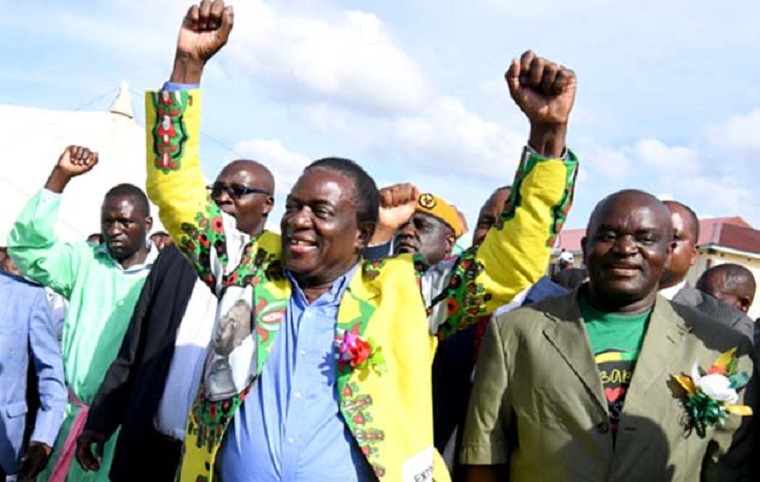
As if that was not enough, Zimbabwe’s President is also facing competition from his former colleagues and subordinates in the junta, in particular from General Chiwenga, his vice president.
In this complex tussle for power, Mnangagwa is doing his best to hold things together while addressing his country’s growing economic and social problems and rebuilding international and regional relations that were left in tatters by his predecessor.
What’s more, Mnangagwa also has to fight an election later this month in which he is facing competition from 23 candidates who are after his job.
It seems that some of his rivals aren’t only trying to bring to an end Mnangagwa’s political career, though; they are also trying to kill him.
In the midst of a rally at White City Stadium in the City of Bulawayo last weekend, a grenade was detonated. Mnangagwa was fortunate: the device landed just behind his security detail as he left the tent.
Dozens of people were injured and two were killed in the explosion. Mnangagwa’s other vice president, Kembo Mohadi, was closer to the blast and remains in hospital in South Africa.
So who was to blame? What seems likely (and this is a view shared by Mnangagwa himself) is that this attack was motivated and organised by the president’s opponents within the ZANU-PF Party.
Since the most likely successor in the event of Mnangagwa’s assassination would have been Vice President General Chiwenga, some suspicion has inevitably fallen on him. Yet this theory is far-fetched: although Chiwenga wasn’t injured in the attack, he was on the stage at the time and was just as vulnerable as Mnangagwa.
Mnangagwa himself has pinned the blame for the attack on the G40 faction led by the wife of his predecessor, Grace Mugabe.
In an interview with the BBC, Mnangagwa said that his ‘hunch without evidence’ is that as this group are likely to have been the most angered by his rise to power, they could well be to blame. “I think this is a political action by some aggrieved persons by the current democratic dispensation in the country,” he said.
There is also another possibility. Tens of thousands of people died in Zimbabwe’s genocide in the 1980s, a time when Mnangagwa was security minister and the country’s chief spymaster.
Mnangagwa has denied responsibility for those deaths, yet it was during this period that he earned his nickname: the crocodile. Now it seems that those affected by those bloody events are out for revenge.
But Mnangagwa’s enemies should be careful. The attack was clearly intended to kill Zimbabwe’s president. Instead it has only shored up his position.
Attacks like these are a reminder of Zimbabwe’s tumultuous recent history, and the president can capitalise if he is able to present himself as a beacon of stability and continuity.
In that sense, the attack failed. Yet it still makes one thing clear: Zimbabwe cannot take its peace and stability for granted. The country’s ghosts are never far away.
By Eddie Cross for the Spectator
(2200 VIEWS)
Zimbabwe has been ranked third among the least free countries in Southern Africa but it…
I had always considered it a curse for a wife to die before her husband.…
This is a true story about the challenges and loneliness I faced when my wife…
My first long-form article in booklet form: Why I had a girlfriend two months after…
The editor and publisher of The Insider, Charles Rukuni, has started a whatsapp channel through…
A friend who knows about my legal battle with Zimbabwe’s richest man, Strive Masiyiwa, way…