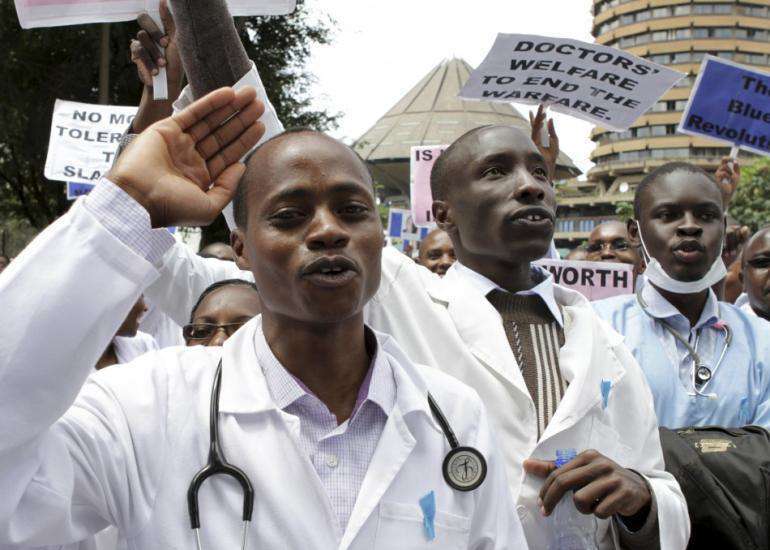
With physicians already scarce worldwide, demand for foreign-born doctors in the United States and the United Kingdom is stretching developing and middle-income countries’ medical resources to the breaking point.
In the US, for example, the shortfall of physicians could grow to nearly 95 000 by 2025, equivalent to 43% of all doctors working today.
When doctors are in short supply, the US and UK turn to countries like the Philippines to close the gap. But this leaves the Philippines with its own significant shortage of medical professionals.
The situation across Africa is no better. In Kenya, more than 50% of all doctors are now practicing overseas, leaving just 20 physicians per 100 000 in the population.
By contrast, the United Kingdom has 270 doctors per 100 000 people.
To be sure, there is nothing wrong with doctors spending time working and training overseas; on the contrary, practicing in a variety of health-care systems is critical for producing experienced, well-rounded physicians.
The fundamental problem is that medical staff and students are leaving the developing world en masse to train in countries like the US and UK, and then never returning to work in their own communities.
Moreover, supplier countries often pay for that medical education directly or indirectly, without ever receiving any of the benefits.
To reverse this trend, we must allow medical students to train in world-class clinical settings, while encouraging them to return to practice in their home countries.
This will not be easy, in part because practicing in developed countries is far more lucrative than practicing in the developing world, and doctors overwhelmingly prefer to work in the countries where they have trained.
Any effort to stop the one-way flow of medical talent from developing countries will have to address these factors.
For starters, we should focus on where medical training happens. Students could complete their preclinical training, and a portion of their clinical training, in their country of origin, and then be given the option of completing a temporary clinical-training stint in the US or the UK.
Residency programs are the last stage of the medical-training process, and they often determine doctors’ preferred practice setting.
Continued next page
(139 VIEWS)
This post was last modified on October 8, 2016 10:54 am
Page: 1 2
Zimbabwe has been ranked third among the least free countries in Southern Africa but it…
I had always considered it a curse for a wife to die before her husband.…
This is a true story about the challenges and loneliness I faced when my wife…
My first long-form article in booklet form: Why I had a girlfriend two months after…
The editor and publisher of The Insider, Charles Rukuni, has started a whatsapp channel through…
A friend who knows about my legal battle with Zimbabwe’s richest man, Strive Masiyiwa, way…