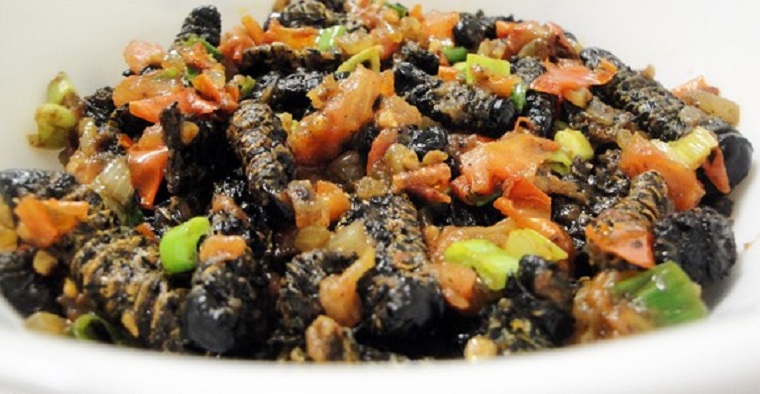
Eating insects is as old as mankind. Globally, 2 billion people consume insects, a practice known as entomophagy. It is more common in Africa than anywhere else in the world.
The continent is home to the richest diversity of edible insects – more than 500 species ranging from caterpillars (Lepidoptera) to termites (Isoptera), locusts, grasshoppers, crickets (Orthoptera), ants and bees (Hymenoptera), bugs (Heteroptera and Homoptera) and beetles (Coleoptera).
The dominant insect eating countries are the Democratic Republic of the Congo, Congo, the Central African Republic, Cameroon, Uganda, Zambia, Zimbabwe, Nigeria and South Africa.
The most commonly eaten insects include caterpillars, termites, crickets and palm weevils.
Scientists have long proposed insects as feed or foodstuff for animals. But views about entomophagy differ widely: food conscious lobbies and scientists promote insects as novel foods while at the other extreme people view eating insects as crazy.
Between those two extremes are communities that have been practising entomophagy for ages.
Most edible insects are harvested from the wild. Little effort has been put into how they could be mass produced and used as a source of protein more generally. To do this, it’s important that the biodiversity of edible insects is understood better, and that indigenous knowledge is uncovered.
To get even this far, however, attitudes to entomophagy need to change. The Food and Agriculture Organisation, anticipating scarcities of agricultural land and water as well as nutrients as the world’s population increases, has spearheaded a fierce propaganda campaign promoting the benefits of entomophagy.
Despite this there is still a reluctance to use insects as food. Added to this is the fact that current biodiversity conservation efforts unfortunately overlook the world of insects.
This needs to change.
Documenting indigenous knowledge systems would be a useful way to promote entomophagy. One of the challenges is that African dialects don’t necessarily provide descriptions that could be used in scientific knowledge. Often species are described based on visual features according to the host plants they feed off or the seasons in which they occur.
Continued next page
(165 VIEWS)
This post was last modified on January 11, 2017 7:36 am
Page: 1 2
Zimbabwe has been ranked third among the least free countries in Southern Africa but it…
I had always considered it a curse for a wife to die before her husband.…
This is a true story about the challenges and loneliness I faced when my wife…
My first long-form article in booklet form: Why I had a girlfriend two months after…
The editor and publisher of The Insider, Charles Rukuni, has started a whatsapp channel through…
A friend who knows about my legal battle with Zimbabwe’s richest man, Strive Masiyiwa, way…