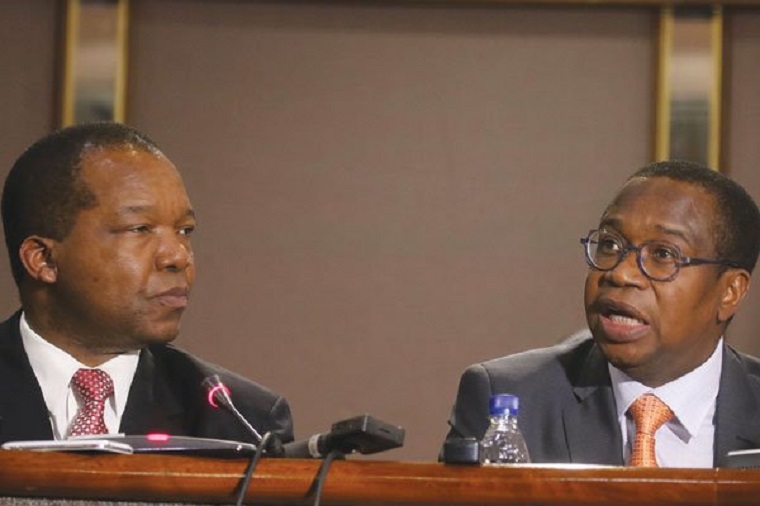
Finance Minister Mthuli Ncube and Reserve Bank of Zimbabwe Governor John Mangudya don’t get on, are pursuing different agendas and at times issue directives without informing each other, two people with direct knowledge of the situation said.
The result: policies that are quickly reversed, confusing contradictions in public statements, an economy that’s forecast by the government to contract 6.5% this year and an annual inflation rate that reached 440% in October.
While Ncube, a Cambridge-trained economist, is often accused of being overly optimistic, his push to cut spending and bring order to chaotic government finances has been lauded.
By comparison, Mangudya, an appointee of former President Robert Mugabe, is seen as a governor who puts political considerations ahead of rational economic decisions.
“They seem to be at two polar opposites,” said Jee-A van der Linde, an economic analyst at NKC African Economics in Paarl, South Africa.
The governor has bristled at the minister taking decisions he feels are within the central bank’s domain since a fallout earlier this year, the people said.
The Zimbabwe Independent on February 15 reported on an alleged row between the two men over how to handle the nation’s monetary policy, citing people it didn’t identify.
The Harare-based newspaper said Mangudya threw paper files at Ncube before he walked out of a meeting. It later retracted the report, saying it was based on “wrong and unverified information”.
There’ve been other points of discord.
On November 29, the Treasury surprised the central bank by issuing an instruction that exporters must pay their bills to the state power utility in foreign currency, one of the people said.
On one occasion, the Treasury told the bank it was issuing a directive and not seeking an opinion, the person said.
Earlier unilateral measures include the Treasury’s abolition in June of the decade-old multi-currency system that allowed the use of the greenback and the South African rand within the country, a decision the central bank then had to implement, the person said.
On September 30, the Treasury directed the bank to issue a ban on dominant mobile-money service Ecocash paying out cash, a move that would have brought the economy to a halt as almost all transactions are done through the mobile platform.
In at least one instance, Mangudya has pushed back.
Continued next page
(197 VIEWS)
Page: 1 2
Zimbabwe has been ranked third among the least free countries in Southern Africa but it…
I had always considered it a curse for a wife to die before her husband.…
This is a true story about the challenges and loneliness I faced when my wife…
My first long-form article in booklet form: Why I had a girlfriend two months after…
The editor and publisher of The Insider, Charles Rukuni, has started a whatsapp channel through…
A friend who knows about my legal battle with Zimbabwe’s richest man, Strive Masiyiwa, way…