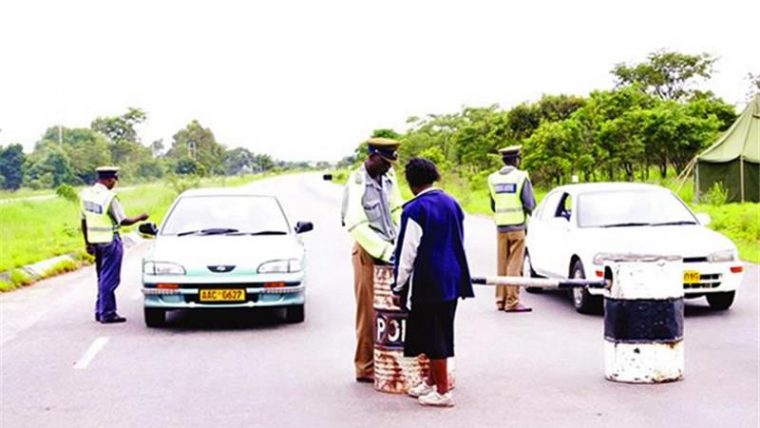
Finance Minister Patrick Chinamasa told the Senate last week that spot fines will remain as long as there are drivers who commit crimes.
The government was, however, seeking ways of improving collection of those spot fines to eliminate corruption.
Spot fines have been heavily criticised because motorists believe the bulk of the money does not go to the government.
They are also believed to be promoting bribery and corruption as motorists, especially public transport operators prefer to bribe the police officers instead of paying the fine.
In some cases police officers extort money from motorists instead of simply issuing tickets.
Responding to issues raised by senators in the second reading of the 2017 budget, Chinamasa said: “I think clearly spot fines will remain as long as we have got drivers who commit crimes when they are driving their vehicles on the road.
“You must expect police to mount roadblocks where they check your speed, the condition of your vehicle and over speeding is a crime for which a spot fine is fixed.
“Any mechanical defect on your vehicle is also a crime.
“You should not move with a car without breaks. So, if the police find that you are driving a car without breaks, they will fine you and they will collect the fine.
“What we are seeking to do though is to improve on the collection of those spot fines so that we eliminate any corruption.
“We are seeking to computerise and connect the roadblock to ZINARA, to the Vehicle Registry and the Ministry of Justice, Legal and Parliamentary Affairs, so that as you get to a roadblock, and you identify yourself or the car, they can tell at the roadblock whether that car is licenced, for instance and if it is not licenced, what would be the appropriate measures to take.
“They can also tell when you give them your driver’s licence that you have been convicted of negligent driving before and you did not pay the fine, or you did not serve the sentence. Thus, we are hoping we will go quite some way to minimise the corruption.”
(108 VIEWS)
This post was last modified on February 12, 2017 7:18 am
Zimbabwe has been ranked third among the least free countries in Southern Africa but it…
I had always considered it a curse for a wife to die before her husband.…
This is a true story about the challenges and loneliness I faced when my wife…
My first long-form article in booklet form: Why I had a girlfriend two months after…
The editor and publisher of The Insider, Charles Rukuni, has started a whatsapp channel through…
A friend who knows about my legal battle with Zimbabwe’s richest man, Strive Masiyiwa, way…