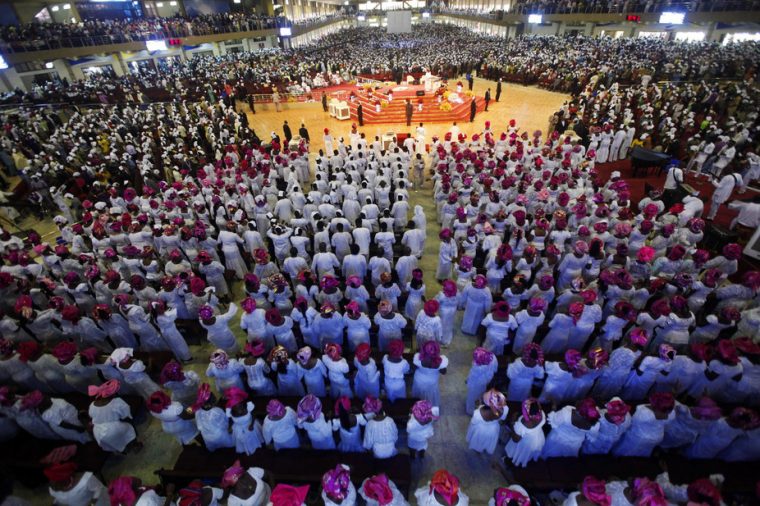
Adoley and her husband Mike (not their real names) attend one of Ghana’s mega churches. Both are university graduates. She is a seamstress and owns a small retail shop. He is an accountant. The couple live with Mike’s family, where Adoley sometimes feels she’s blamed for the couple’s childlessness after having three miscarriages.
When they visited our home in Accra one Sunday in December 2015, Adoley complained about a few things, such as Mike refusing to carry her handbag in church while she went to the bathroom, because – as he explained – “a man doesn’t carry a woman’s bag”.
This anecdote points to a bigger story about the church in Africa today, and the messages that some of its influential male leaders promote about masculinity, marriage and gender roles in society more broadly.
While churches in the economic north are emptying out those in the Global South – and especially Africa – are growing. Pentecostal and charismatic churches have mushroomed, many influenced by a wave of American-exported evangelicalism in the 1970s and 1980s.
Churches also carry out important social functions the state has neglected. They are involved in addressing HIV/AIDS, building hospitals and establishing universities. This kind of work – sometimes called the “social gospel” – makes the church much more than simply a religious space. The modern African church promises a life that is abundant and prosperous – both spiritually and materially.
African church leaders – the bishops and archbishops, prophets and overseers, pastors and deacons, benignly referred to as “men of God” – are powerful. Their teachings have a wide reach that is not limited to Sunday mornings and mid-week services. There are TV and radio programmes, audiotapes and books, international branches and YouTube videos that reach a wide audience beyond their own congregations.
Continued next page
(150 VIEWS)
This post was last modified on June 17, 2017 9:10 pm
Britain says amendment of the Zimbabwe constitution is a sovereign, legislative matter for Zimbabwe to…
It is now 47 years since I wrote the short story below for a South…
Zimbabwe has released its 2026 monetary policy statement in which it seeks to stabilise its…
Far from it, on paper that is. Ignatius Chombo was one of the longest serving…
Zimbabwe on Thursday announced a ZiG290.9 billion budget with revenue expected to be ZiG287.6 billion,…
The International Monetary Fund says Zimbabwe’s economic recovery in 2025 is stronger than previously anticipated…